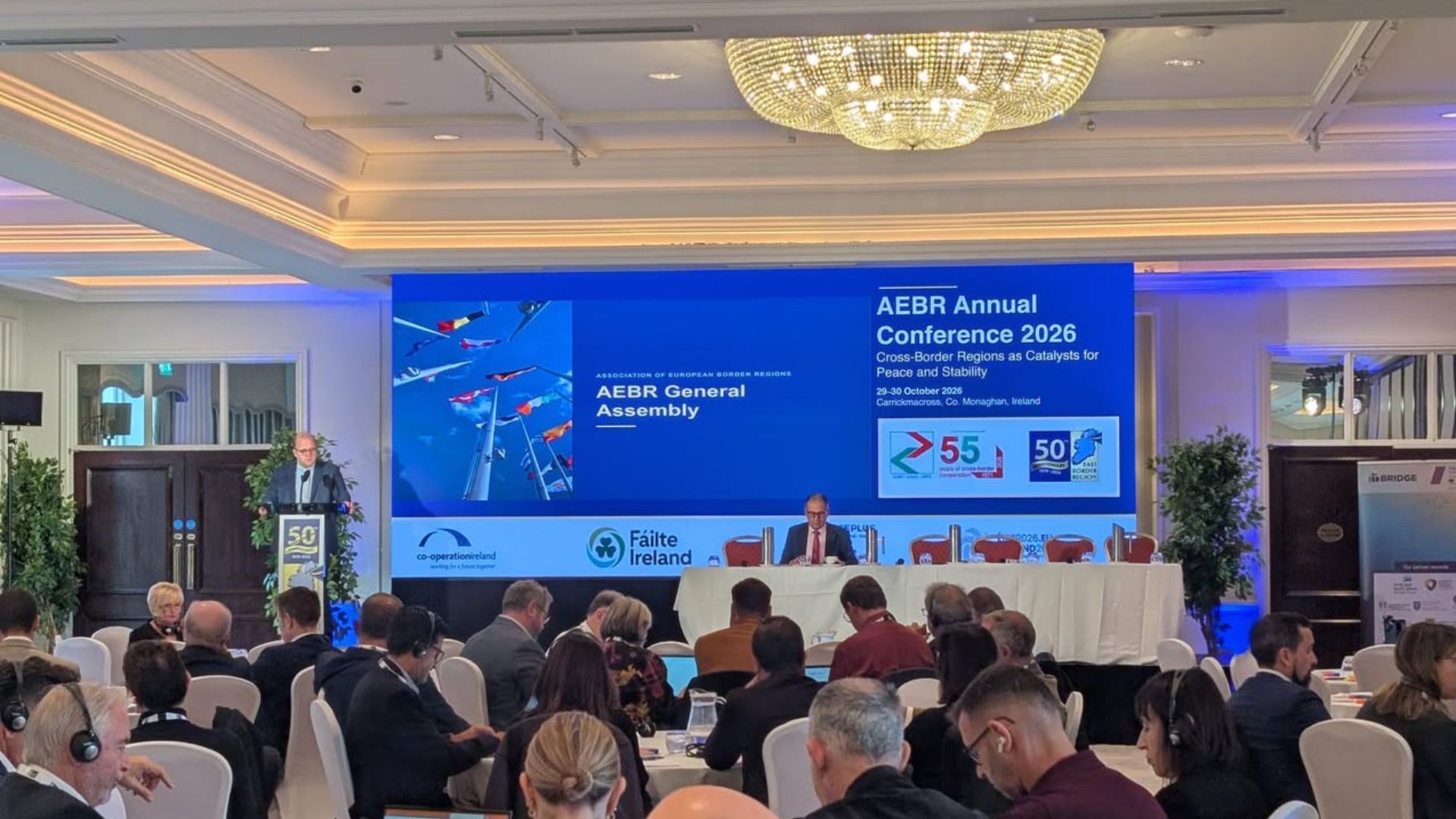
The Association of European Border Regions (AEBR) held its General Assembly and Annual Conference from 28 to 31 October 2026 in Carrickmacross and Dundalk, in the border region between Ireland and Northern Ireland. More than 180 delegates from 26 countries discussed territorial cooperation, peace, EU enlargement and the future of Interreg programmes. The meeting highlighted the role of border regions in political stability, relations between communities and the development of joint projects.
East Border Region (EBR) hosted the events in Dundalk, County Louth, and Carrickmacross, County Monaghan, as it marked its fiftieth anniversary. Founded in 1976, the organisation brings together six local authorities on both sides of the Irish border. An AEBR member for 34 years, it had previously hosted two of the association’s conferences, the first in 1992. The 2026 programme included the tenth Cross-Border School on 28 October in Dundalk, the General Assembly and two conference days on 29 and 30 October in Carrickmacross, followed by a cross-border visit on 31 October.
Fifty years of cooperation on the Irish border
The conference focused on cross-border regions as catalysts for peace and stability, placing the Irish experience in the context of new geopolitical tensions in Europe.
Thomas Byrne, Ireland’s Minister of State for European Affairs and Defence, opened the proceedings by recalling how the border between the two parts of the island had changed. He noted that the local authorities belonging to East Border Region had helped transform an area of division into a territory of cooperation and innovation.
For fifty years, EBR has developed partnerships between local authorities, mobilised European funding and supported joint projects. Its experience illustrates how territorial institutions help bring communities closer together alongside political agreements between governments.
Discussions also addressed border resilience, deliberative democracy and citizens’ participation in decisions affecting their territories. Participants examined ways to strengthen institutional and social relations in cross-border areas, including places experiencing conflict or reconstruction.
Interreg and PEACEPLUS in the next EU budget
The future of EU cohesion policy featured prominently in the proceedings. Nathalie Verschelde, Head of Unit at the European Commission’s DG REGIO, and Andrew Condon, an Irish official responsible for cohesion funds and North–South structural programmes, outlined prospects for the next Multiannual Financial Framework, covering 2028–2034.
The discussions pointed to the prospect of continued support for Interreg and PEACEPLUS, which promotes peace and cooperation between Ireland and Northern Ireland. The final rules will nevertheless depend on EU negotiations; participants did not expect complete clarity before mid-2027.
For border regions, these programmes provide tools for institutional cooperation and territorial development. They enable authorities from different countries to set shared priorities and finance initiatives in transport, services, the environment, the economy and relations between communities.
AEBR advocates preserving this territorial dimension in the reform of EU funding and involving cross-border bodies in preparing and managing future programmes.
Two initiatives for cross-border employment and services
On 29 October, AEBR awarded the 2026 Sail of Papenburg prize to the Nouvelle-Aquitaine–Euskadi–Navarre Euroregion for its cross-border employment strategy, developed through the Interreg POCTEFA AFOMEF LANEAN project.
The initiative seeks to coordinate employment policies more closely between French and Spanish territories, facilitate labour mobility and address the difficulties facing workers and businesses on either side of the border.
The jury also gave a special mention to the Greater Region for a cross-border chatbot developed by Frontaliers Grand Est. This tool makes information and services easier to access for people who work or live on either side of a border.
Both projects show how Euroregions and territorial networks work in practice: they identify administrative obstacles, coordinate public-sector actors and offer joint solutions to residents.
Territorial cooperation as an instrument of European stability
The tenth AEBR Cross-Border School, held in Dundalk on 28 October with Radboud University in Nijmegen and the University of Victoria in Canada, complemented the institutional discussions. Researchers and practitioners explored cross-border governance, human security, trust between communities, sustainable development and cooperation in territories affected by conflict.
The Annual Conference also examined the prospects of an enlarged Europe and ways to apply cooperation experience to other European borders.
On 31 October, participants visited the construction site of the Narrow Water Bridge between Ireland and Northern Ireland, after viewing parts of its structure in Warrenpoint. This infrastructure project offers a tangible example of how institutional cooperation takes shape in border territories.
In October 2026, AEBR also became co-chair, alongside DG REGIO, of the European Commission’s Youth4Cooperation initiative. The initiative seeks to strengthen young people’s participation in European territorial cooperation and Interreg programmes.