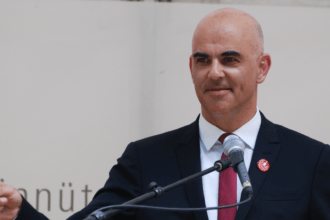
On the 50th Session of the Congress of Local and Regional Authorities, in Strasbourg, on 31 March, Peter DRENTH (Netherlands R, EPP/CCE) delivered this speech, during the debate on report “Squeezed out? Bringing regional history teaching to the fore”
This report focuses on regional history and the role of regional authorities in educating people on it.
The report underlines why teaching regional history matters. It brings the past closer to learners — connecting them to their communities, their cultural heritage, and their shared environment. While national and global narratives provide essential context, regional history offers a human-scaled perspective, helping students understand where they come from and how their regions evolved. This has long been understood by the Council of Europe, which advocated regional history teaching from its early years.
Of course, this approach must be balanced — regional narratives should not be distorted by bias or prejudice. That is why linking regional history with human rights, civic education, and democratic citizenship is so important. Rather than avoiding controversial or uncertain topics, we should use them to build students’ critical thinking — encouraging the use of oral history, interviews, and local archives. Done well, this encourages critical thinking and consideration of multiple perspectives – even reconciliation, particularly in divided or historically contested regions.
The term “regions” is understood broadly — not only as formal subnational entities, but also as transnational or cultural regions that share ethnic, linguistic, or historical commonalities beyond present-day borders. This includes, for example, the Sámi people in the Nordic countries, or historical regions such as Thrace, once part of empires and now divided between Greece, Türkiye, and Bulgaria.
Across Europe, we see that regional history is taught most extensively in areas with a strong cultural identity and in federal or devolved countries where regions have powers over education. For example, in Germany federal states and in Belgium linguistic communities design their own curricula. Spain’s autonomous communities and Italy’s regions with special status integrate their history flexibly. In the United Kingdom, devolved administrations such as in Scotland develop distinct history programmes.
Even in unitary states, regional authorities contribute through implementation and extracurricular activities. For instance, Dutch provinces like Gelderland that I represent, support museums and cultural institutions to promote regional commemoration and heritage.
It is however true that this report finds that countries with centralised education systems are more likely to exclude regional history from the curriculum.
This squeezing out is in fact a general feature.
Regional history remains underrepresented in curricula and textbooks across Europe. Teachers often face overloaded programmes, lack of time and training, scarce resources, and limited guidance on how to teach regional history critically and creatively.
Access to primary sources also poses challenges, and these remain underdeveloped
In general, since the Council of Europe first made clear the importance of regional history teaching, it has lost out from a move – sometimes a very deliberate move – to concentrate on national, European and broader global history teaching instead.
So what can we do to improve this situation and lever regional history teaching back on to the agenda?
In decentralised systems, regional authorities can use their powers to make curricula more open and inclusive, strengthen teacher training, and address sensitive or traumatic regional histories constructively.
In centralised systems, cooperation between national and regional authorities is essential — to recognise the value of regional history, provide time in the curriculum, support extracurricular activities, and produce quality teaching materials.
In both cases, regional politicians can lobby for this change.
Beyond the classroom, regional authorities can play a key role — supporting museums, archives, universities, and civil society to develop educational projects, exhibitions, and digital archives. They can promote innovative school projects, establish awards, and engage students in local historical research. Trans-regional and cross-border cooperation can further foster mutual understanding as we have seen in examples such as the “Making Visegrad History Digital” initiative digitising and interpreting the shared historical narratives of the Visegrad countries—Poland, Hungary, the Czech Republic, and Slovakia.
The draft Resolution calls on local and regional authorities to collaborate with national authorities and other stakeholders to ensure the allocation of sufficient time, space and resources for teaching regional history within school curricula. It highlights, among other things, the need for good teacher training, accessible teaching materials, stronger cooperation with cultural institutions, and a greater focus on diversity.
The draft Recommendation calls on national authorities to recognise the importance and complementary role of regional history alongside national, European, and broader international history, and to allocate sufficient time, space, and support to its teaching. It particularly advocates for stronger international cooperation.
I am grateful to the expert Dr Angelos Palikidis, Professor of History Didactics from Greece who contributed to the preparation of this report and for the support in this process of the European Association of History Educators (Euroclio) and the Council of Europe History Education Division and the Observatory on History Teaching in Europe.
There is very little existing research on this topic, so this report really does break new ground and it owes much to the collective expertise and contributions of all those involved. By approving it, we affirm that regional history teaching is essential for building inclusive, democratic, and culturally rich societies — where the recognition and examination of Europe’s regional histories can heal divides and strengthen our communities and our continent today.
I would be happy to hear whether you recognise the issue described here in your own regions and countries, and whether you think that these solutions might benefit student – and others – that you represent.
Thank you.