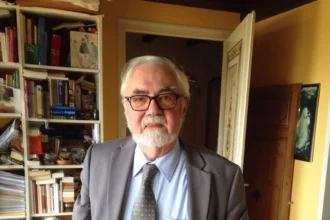
A presentation by Professor Charles Ricq at the symposium ‘Regions, cornerstones of a federal Europe’, Strasbourg, Council of Europe (5–7 June 2008), exploring the thinking of Denis de Rougemont.
Geneva, 6 June 2008
Introduction:
Denis de Rougemont (DdR) was a ‘European citizen’ and ‘committed writer’ born in Couvet (Neuchâtel, Switzerland) in 1906 and died in Geneva on 6 December 1985.
His main works:
- Politique de la personne (1934)
- Penser avec les mains (Thinking with the Hands, 1936)
- L’Amour et l’Occident (Love and the West, 1939)
- L’Europe en jeu (Europe at Stake, 1948)
- L’un et le Divers (The One and the Many, 1970)
- Lettre ouverte aux Européens (Open Letter to Europeans) (1970).
- L’Avenir est notre affaire (The Future is Our Business) (1977)
- Rapport sur l’état de l’Union de l’Europe (Report on the State of the European Union) (1979)
Cooperative and contractual federalism, vertical and horizontal; in other words, “cooperation, partnership and therefore autonomy, interdependence and/or based on the individual and/or collective person”.
Three major “focuses” of reflection and writing in DdR
- The 1930s: the individual and the community, the ethics of federalism
- The 1950s: the cultural roots of Europe
- The 1970s: regions, the cornerstones of the federal construction of Europe.
Part 1: Personalism and the ethics of federalism
For DdR, the individual represents the foundation of European values, and therefore of any federal construction of Europe. In his view, the human person is defined and understood as much by their commitment as by their relationship with others, and therefore there can be no person without a community, nor a community without people. For any federalist, this means that the ultimate goal of any political community is the development of the person, while anticipating and respecting differences; federalism therefore expresses and reflects human diversity.
For DdR, the ethics of federalism are based on the following core values:
- respect for others (i.e. “affirming the right to be different”)
- self-respect (i.e. “the duty to be oneself”)
- taking reality into account with humour (i.e. “active pessimism”)
- an understanding of the paradox linked to the complexity of ‘the one and the diverse’ (i.e. ‘the federalist is someone who has understood that the smallest is less vulnerable but also more effective’)
For DdR, the originality of federalism, on a personalist basis, also lies in the fundamental link between thought and action (i.e. ‘thinking with one’s hands’).
Some quotes from Denis de Rougemont on personalism and federalism:
In his first personalist book, Politique de la personne, published in 1934, DdR wrote:
“Politics, i.e. any system that aims to govern people, must be based on a definition of the person, their value and their ends.
This politics on a human scale must be the expression of the person himself…‘.
’The ultimate foundation of any real and actual community, this “telos” that animates everything, can only be the person” (Penser avec les mains, 1936).
‘From my earliest writings, around 1932, I have constantly called for the union of Europe in the name of federalist doctrine. I found this doctrine to be implicit in a philosophy of the person, which a few of us were constructing in the midst of a totalitarian tide…’ (Europe at Stake, 1948)
‘The human person is man considered in his dual reality as a distinct individual and as a citizen engaged in society…’ (The One and the Many, 1970)
‘The philosophy of the person is the only philosophy acceptable to the federalist…’ (Mission or Resignation of Switzerland, 1940)
‘True society is nothing other than a dimension of the person…’ (L’Avenir est notre affaire, 1977)
For DdR, the person is ‘free and committed’, “free and responsible towards his neighbour and his community ‘… ’The true relationship between people is a community of responsible individuals‘ (Penser avec les mains, op. cit.).
However, DdR is aware of the limitations of a certain type of federalism: ’the inherent flaw of federalism is that it is a dialectical, ambiguous concept that sometimes allows for the most implausible conceptual blunders ‘ (Open Letter to Europeans, op. cit.) , which led him to invent – and he repeated this to me many times – the term ’active pessimist”.
Part 2: Federalism and regions
Distinguishing between federalism and federalisation, regionalism and regionalisation is crucial for a political scientist such as myself.
DdR’s key idea: from the individual to the regions through federalism. It should be noted that, for DdR, the couple constitutes the smallest federalist entity; then come the city, regions, state, continent and planet (global federalism): ‘a European federation is only conceivable with a view to a global federation’ (L’Espace européen, 1947)
Like Proudhon, but from a personalist perspective, DdR envisages Europe as a federation of federal regions, with the regions becoming models of ‘federalist communities’. And already, at the Hague Congress (May 1948), as well as at the creation of the European Union of Federalists (U.E.F.) in Montreux in August 1947, DdR wrote that federalism was intrinsically linked to ‘the fulfilment of the human person through communities of daily life’.
Some quotes from Denis de Rougemont on federalism and regions:
“Uniting beyond our false sovereignties to preserve our true diversities means creating a federal power to safeguard our autonomies. For these autonomies will be lost one by one if we refuse the union that would make them strong; but, in return, this union cannot be achieved at the expense of the freedoms it is supposed to serve… ‘ (L’Un et le Divers, op. cit.).
’To govern (at all levels) is to coordinate the simultaneous action of elements that are diverse in their diversity and based on their autonomy. To federate, i.e. to indicate common goals to autonomous units, these goals may be short- or long-term, but must be constantly oriented towards the ultimate goal of the secular state, which is the freedom of individuals…” (Notes pour une éthique du fédéralisme, 1979).
‘If we want to unite Europe, we must build on what is destined to become the true reality of our society tomorrow, namely a new type of unity, both larger and more complex than the ancient city, but denser and better structured and offering a better environment for civic participation than the nation: the region.’ (Open Letter to Europeans, 1970).
‘Building this European federation of people and organic groups – the regions – … means ensuring the effectiveness of our action in European culture for the future’ (Thinking with the Hands, op. cit.).
In ‘The Future is Our Business’ (1977), his last book, DdR makes this plea: ‘create Regions and federate them, with all that this implies in terms of self-management at different levels, responsibility towards others and personal adventure to be pursued in a restored community’… ‘The Region… enables, implies and promotes a Federation of Europe, based on communities of all kinds, which are complementary rather than competitive.’
Part 3: Federalism and the basic principles of European integration
To be distinguished: functionalism in Jean Monnet federalism in DdR
European integration, on a federalist basis, is based on the fundamental principle of ‘unity in diversity’, which DdR calls ‘differentiated unity’ (L’Un et le Divers, op. cit.). . This same European integration is also rooted in the ‘civic culture’ of each person, taking into account their ethical, cultural and spiritual goals, namely the nature of the person, the goals of life in the City, the true goals of any autonomous and interdependent region. Conceived and envisaged in this way, the European Community will be more than just an example of directives and regulations, however useful they may be, because for DdR, regions are above all ‘spaces for civic participation’.
More fundamentally still, DdR sees European construction, both now and in the future, through its cultural foundation, its ‘cultural unity’. ‘We are federalists, i.e., we want all differences to enhance each other through their opposition and create fruitful tensions’ (Journal d’une Epoque, ed. Gallimard, 1968).
Some quotes from Denis de Rougemont on federalism and European integration:
‘Europe, homeland of diversity…’ (L’Un et le Divers, 1970).
‘Europe must first and foremost mean union in diversity and respect for diversity…’ (Le Cheminement des esprits, 1970).
“European unity, not homogeneous and not resulting from a forced process of standardisation, levelling and exclusion of what is different, but on the contrary encompassing and broadly composing, in a community that has become increasingly complex over the centuries, often contradictory values, from multiple origins, whose contrasts and combinations maintain relentless tensions…” (L’Un et le Divers, op. cit.).
‘The federalist problem, a situation in which two contradictory but equally valid and vital human realities clash, such that the solution cannot be sought either in the reduction of one of the terms or in the subordination of one to the other, but only in a creation that encompasses, satisfies and transcends the requirements of both…’ ” (L’Un et le Divers, op. cit.).
N.B. In this last text, DdR refers not only to Greek philosophers: Plotinus, Heraclitus (‘what opposes, cooperates, and from the struggle of opposites proceed the most beautiful harmonies’)… but also to more recent philosophers such as Hegel, Proudhon, Mounier, etc., and even to Protestant theologians such as Karl Barth…
‘Personalism leads to a federalist formula for Europe, which will not necessarily be the most powerful or the richest, but rather that corner of the planet where people of all races will be able to find, if not the greatest happiness, perhaps the greatest meaning in life’ (Open Letter to Europeans, op. cit.).
Conclusion:
In my view, and to summarise DdR, I would say that:
‘everything that cooperates, federates’
and
‘everything that federates, cooperates’
in the name of the two inseparable basic principles of autonomy and interdependence, both for individuals and communities.
DdR did not have only friends. The journal Esprit, to which he contributed in the 1930s, attacked him vigorously in a special issue in the autumn of 1948, through articles by E.
Mounier (‘European federalism, an outdated legacy of the pre-war period’) and J.M. Domenach, who saw the federalists as a coalition dominated by the right, stating that ‘uniting Europe without transforming it socially will create an economic zone serving America against the USSR…’. It should be noted that at the Montreux Congress in May 1948, DdR put forward the following alternative: ‘There is no longer socialism and capitalism; there are only two possible attitudes: federalism and totalitarianism.’ In fact, he had vehemently condemned Nazism as early as 1933, which led to him being sent to the United States by the federal authorities in the early 1940s.
De facto, Europe is on the path to ‘federalisation’. It is becoming federalised through several indicators – this is what Jacques Delors called the emergence of a ‘Europe with federal structures’. To confirm this, we can cite the transfer of powers – Community law – and, with the future Treaty of Lisbon, the new powers of the European Parliament, the progress made in the ‘qualified majority’ rule to the detriment of the unanimity rule. We should also note the strengthened territorial cohesion, with a budget of €336 billion for the period 2007-2013, the creation of the euro in 1999, the Single Market in 1986, etc.
Even though DdR never used the terms subsidiarity, governance, proportionality, proximity, etc., which have become almost commonplace even outside the European institutions in Strasbourg and Brussels, all his writings confirm that his thinking, without using these terms, developed their spirit. I will quote, for example:
‘I love the state so much that I want it on every floor’;
for him, it was therefore a question of redistributing structures and competences, even if he sometimes added ‘less state, more Europe’.
As for regional, national and European citizenship, DdR never missed an opportunity to remind people that he was first and foremost a ‘European citizen’, which, when I drove him home in the evening, across the border, never failed to excite the French customs officers when he forgot his identity papers. And when he referred to civil society and NGOs in his daily life, it was also in the name of citizenship.
And partnership (a term that does not appear in his writings either) was part of his ethic of federalism – cooperative or contractual federalism – which assumed, even at the level of any group, and a fortiori for regional, national and European communities, that every person, individual or collective, free, autonomous and responsible, could enter into a contract. This partnership, whether vertical and/or horizontal, was the very basis of his objective of a federated Europe, a European federal state that was ‘one and diverse’.
The Chamber of Regions in Strasbourg and the Committee of the Regions in Brussels, created in May and March 1994 respectively, can therefore work, each according to its competences and means, to ensure that the regions increasingly become the cornerstones of a federal Europe that is already emerging; this is indeed the system that would best suit the diversity of countries and regions in Europe.