The many challenges we face are interconnected, arise at the same time, but can’t any longer be tackled in a stable and a predictable environment. Even worse, facing what’s going on since last week in the Middle East.
We have enjoyed a long period of peace, certainty, international cooperation and solidarity. But linking up with the certainties of the past will not work for the future. There is unfortunately no room for nostalgia.
Canadian Prime Minister Mark Carney probably was expressing it the most clearly in Davos, emphasizing the end of the rules-based international order. Our times remind me of Stefan Zweig’s penetrating book ‘ The world of yesterday’. In it, he describes what Vienna’s golden age meant for the good life, art, culture, prosperity and well-being before the disruption of the interbellum, and the subsequent rise of Nazism with all its horrors.
We are not living in peaceful woods but are confronted with a new world order where fortresses are combating each other, each trying to be the strongest and finally the strongest is the winner taking it all, leading to permanent wars, as Yval Noah Harari stated. We must on the contrary integrate the defeated as well in our societal model, as a peacekeeping attitude.
The prevailing narrative is that Europe is in danger. First and foremost, military danger — but not only that. Four years after the Russian attack on Ukraine, more than one year after the return of D. Trump into the White House, we face a time in which deterrence, hard power and preparedness have returned to centre stage. At the recent Munich Security Conference, several speakers described the current moment as the end of illusions and of sustainment and solidarity. Marco Rubio’s speech was more gentle than the one of the US Vice- President one year before, but stating in fact the same: Europe is in decline and must change in line with the White House’s Strategic Agenda. But there is evidently no good reason to doubt on our European values, assets or strengths nor to surrender for autocrats, technocrats and kleptocrats taking over democratic institutions. And no good reason to abdicate from democratic rules and instead use soft power in our societies to complement the institutional power.
Our answer must be threefold.
First of all, secure the freedom to be who we are, to say what we think, prerequisites for a vibrant democracy, respect for human rights and the rule of law.
Secondly, strengthen Europe’s competitiveness, based on a social, sustainable market economy and the challenges this concept poses for our European social model.
Thirdly, take our defense to heart, because protection and security of people are also part of the integrity of human beings and moral argument for defense investment. Europe in essence is and will remain a peace project. That is why it’s necessary to defend our European values.
In response, – after quite some hesitation – the EU has launched a broad and far-reaching agenda: strengthening defence capabilities and industrial capacity, mobilising new financial instruments, revising fiscal frameworks, promoting joint procurement, investing in innovation and critical technologies, addressing supply-chain resilience, and redefining partnerships and strategic autonomy. Readiness 2030, mobilizing 800 billion euro, is an answer to geopolitical threat and uncertainty of American military support and solidarity.
We must critically examine assumptions that are often presented as self-evident and reflect also on the evolving role- and crisis – of international organizations, how security has returned to the center of political debate and why rearmament is increasingly portrayed as an unavoidable priority.
It might be interesting to note that already in 1950, five years after the Second World War, the idea of a joint European army under European control was discussed and even adopted in the Council of Europe. Jean Monnet, Konrad Adenauer, Winston Churchill, Alcide de Gasperi and others were backing this idea at that time…today we discuss European rearmament, being far from a European army.
If defense is necessary, it must remain one element within a broader set of instruments aimed at ensuring lasting peace. Security cannot be reduced to military strength alone. What is the role of diplomacy, multilateral cooperation, social justice and social dialogue in building sustainable security? How can the European Union contribute to protecting human dignity while responding to real threats?
We must assess the economic and social implications of the current wave of rearmament in EU Member States. How are rising military expenditures financed — through debt, taxation, or reallocation? What difference does this make? Should we expect trade-offs between defense and social spending? And how robust is the assumption that higher defense spending will automatically generate growth and employment? And if increased defense investment is deemed necessary, how can it be structured to maximize societal return?
One of the European Commission’s simplification packages is aimed at removing bottlenecks and accelerating defense production. It raises important questions as the appropriate balance between the mobilization of public resources — including easier access to European funds and simplified procurement — and the benefits delivered to society as a whole. Does regulatory simplification address the deeper structural weaknesses of Europe’s defense industrial base, or does it risk overlooking them?
If Europe chooses to rearm, we must be honest about the implications. Terms such as “strategic autonomy” or “readiness” cannot substitute for careful scrutiny of political choices. Even when facing genuine security threats, democratic societies must remain capable of critical reflection.
A critical debate emerges regarding the balance between security instruments, welfare and wellbeing, avoiding risks austerity in healthcare, education, public services, just transition, militarization or increased surveillance of marginalized groups and threatening social cohesion. Social justice in this context, requires ensuring that rearmament does not worsen inequalities or undermine the European social model.
There are also several ethical aspects of armament: use Autonomous Weapon Systems with the difficulty to assign responsibility, accountability and human control, arms production and research, arms trade and proliferation, controversial weapons, nuclear deference. The use and impact of AI for armament is a new risk. Last days Dario Amodei, the CEO of Anthropic refused to make its AI tools available to the US military without restriction and is now therefore being barred by the US government.
Confronted with an autocratic governance in the US and dictatorship in Russia and China we must first and foremost be aware and recognize the risks we are confronted with.
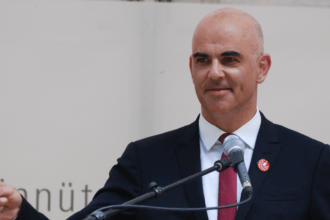
Alain Berset, the Secretary-General of the Council of Europe, put it this way two weeks ago at a conference organized by the Jean Monnet Centre at the University of Lausanne: ‘we are about to strengthen our defense capacity in order to defend our democracies’. At the same time, we need to invest as much as in rearmament to defend our democracies, our democratic institutions. Democracy needs to be strong to control military forces. The real security starts with the democratic strength of institutions and the protection of human rights.
Democratic decision-making, international law and rules, truth, values and social justice must continue to guide us. At all levels of governance, from the local over the regional, the state to the European Union.